
Deploy on Google GKE
Run tenantplane on Google Kubernetes Engine.
This guide deploys tenantplane on a GKE Standard cluster with Persistent Disk storage and optional exposure through a Google Cloud load balancer.
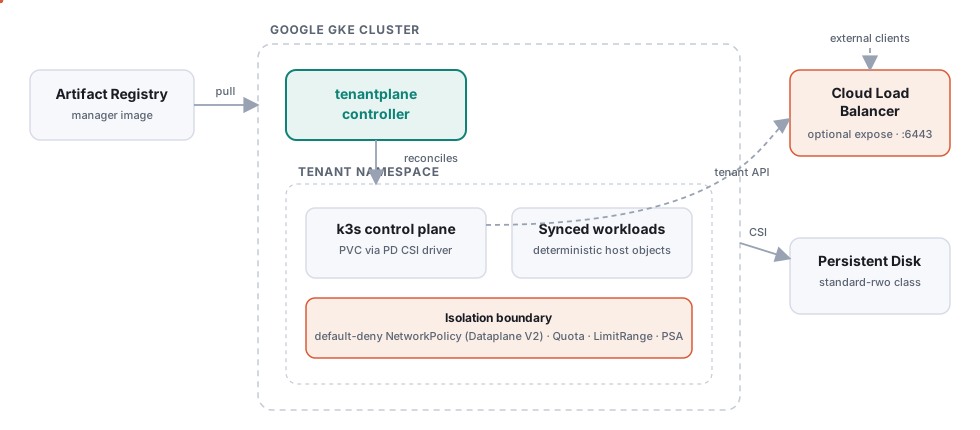
Prerequisites
gcloudCLI authenticated, pluskubectlanddocker- A GKE Standard cluster with network policy enforcement. Dataplane V2 has enforcement built in:
gcloud container clusters create tenantplane \
  --zone us-central1-a --num-nodes 2 --machine-type e2-standard-2 \
  --enable-dataplane-v2
gcloud container clusters get-credentials tenantplane --zone us-central1-a
(On older clusters, --enable-network-policy enables Calico instead. GKE
Autopilot is not yet validated for tenantplane.)
1. Storage
GKE ships CSI-backed StorageClasses out of the box. standard-rwo
(pd-balanced) is the default and works well for control planes:
kubectl get storageclass
2. Push the controller image to Artifact Registry
gcloud artifacts repositories create tenantplane \
  --repository-format=docker --location=us-central1
gcloud auth configure-docker us-central1-docker.pkg.dev

make docker-push IMG=us-central1-docker.pkg.dev/<PROJECT_ID>/tenantplane/manager:dev
3. Install tenantplane
kubectl apply -f config/crd
# Point the Deployment at your Artifact Registry image, then:
make deploy
kubectl -n tenantplane-system rollout status deploy/tenantplane-controller
4. Create a tenant with Persistent Disk storage
spec:
  controlPlane:
    storage:
      className: standard-rwo
      size: 2Gi
kubectl apply -f config/samples/isolationprofile_restricted.yaml
kubectl apply -f config/samples/syncpolicy_default.yaml
kubectl apply -f config/samples/tenantcluster_cloud.yaml
kubectl -n team-dev get tenantcluster cloud-dev -w
5. Optional: expose the tenant API via a load balancer
For an internal (VPC-only) load balancer:
spec:
  controlPlane:
    expose:
      loadBalancer: true
      annotations:
        networking.gke.io/load-balancer-type: "Internal"
Omit the annotation for an external passthrough load balancer. Read the provisioned address from status:
kubectl -n team-dev get tenantcluster cloud-dev \
  -o jsonpath='{.status.externalEndpoint}{"\n"}'
Add that IP to spec.controlPlane.extraTLSSANs so the tenant API certificate
covers it (the control-plane pod restarts to pick up the new SAN), then point
your kubeconfig’s server: at the external endpoint.
Notes
- Persistent Disk is
ReadWriteOnce, matching the single-replica control plane this milestone supports. - Pod Security: tenantplane enforces
baselineon tenant namespaces (withrestrictedaudit/warn) so the k3s control-plane pod is admitted — see the IsolationProfile docs.
Found a gap? Open an issue or PR.